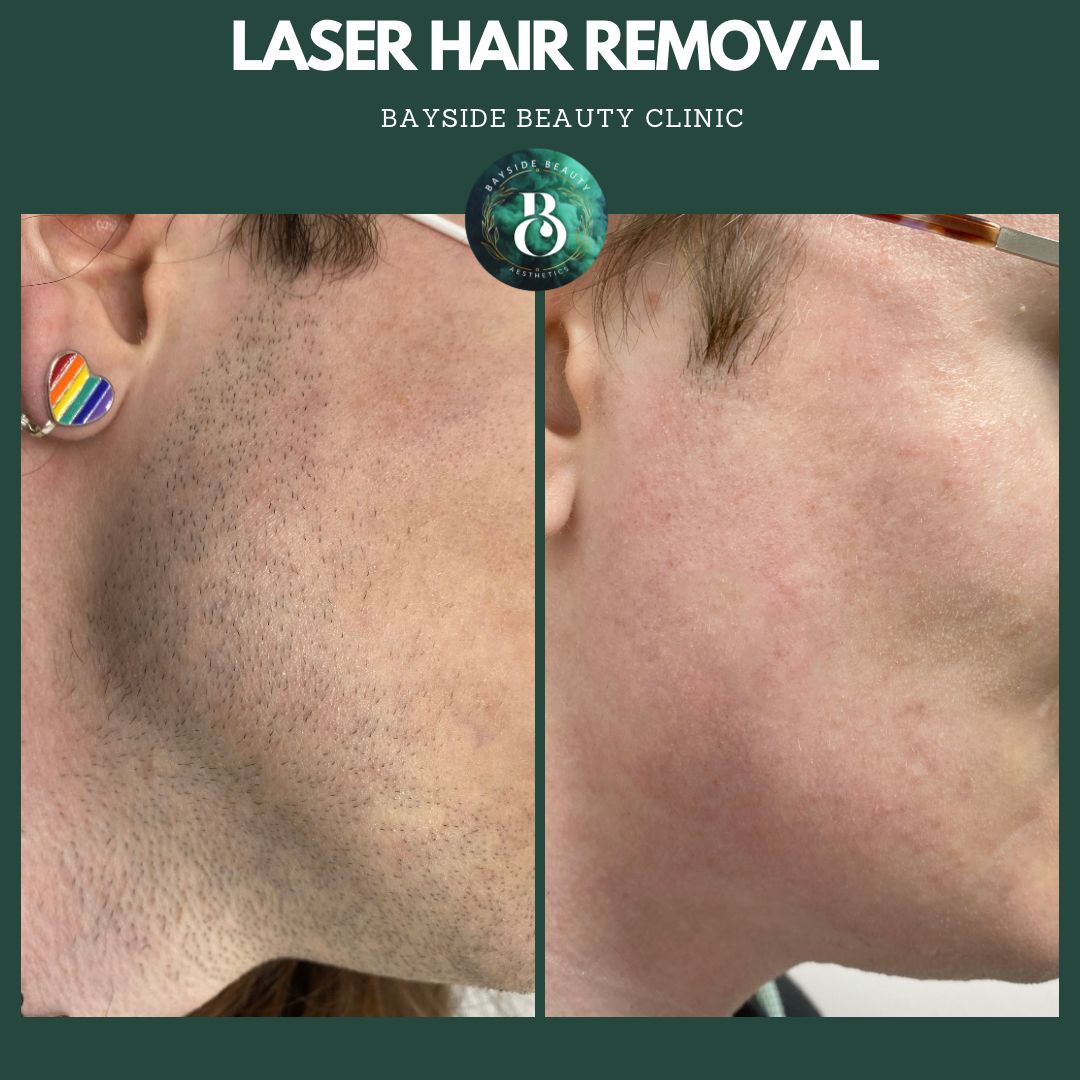
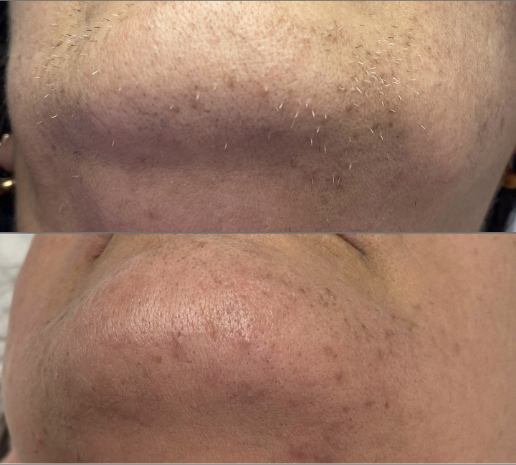
How does laser hair removal work on men's coarse hair?
Laser hair removal works by heating the pigment in the hair, so the darker and coarser the hair, the more readily it responds. The light pulses are absorbed by melanin in the hair, and the follicle is targeted so that the hair falls out and further growth is reduced. A 2020 review describes the ideal candidate as someone with thick, dark hairs and light skin, and the NHS Bristol Laser Centre says treatment is most effective on coarse, dark hair. Dark beard, chest or back hair fits that description.
A laser can only act on hairs that are actively growing, because melanin is only present in the hair during that phase. The same review notes that at any one time around 10 to 15% of hairs may be resting or in transition, so treatment has to be spread over many months to reach each follicle as it comes back into growth. This is why laser hair removal for men is planned as a course rather than a single appointment.
The evidence supports reduction rather than total removal. A 2006 review of controlled trials concluded that lasers give a partial reduction in hair for up to six months after treatment, that results improve with repeated treatments, and that there was evidence of partial long-term reduction after repeated treatment with alexandrite lasers, and probably with Nd:YAG lasers. It found no evidence for complete and persistent removal. Our Candela GentleMax Pro combines both of those wavelengths, alexandrite at 755 nm and Nd:YAG at 1064 nm.
Can laser help with beard line and neck razor bumps?
Laser can be an alternative to shaving for men who get razor bumps along the beard line and neck, although results vary. Razor bumps are known medically as pseudofolliculitis barbae, an inflammatory reaction of the hair follicle that appears most often on the face and neck of men after shaving. DermNet says it is more common in people with darkly pigmented skin, in those with curly or coarse hair, and in blade razor users than in people who use electric shavers. It lists laser therapy among the alternative hair removal techniques to consider.
Ingrown hairs follow a similar pattern. The NHS says they are more likely with coarse or curly hair, and suggests trying an electric razor rather than wet shaving.
Beard laser hair removal needs more careful planning than body areas, for two reasons. First, facial hair tends to respond less than body hair, as the section on sessions explains. Second, a 2021 meta-analysis of laser and IPL hair removal estimated that paradoxical hypertrichosis, an uncommon and poorly understood effect in which hair growth increases after treatment, affected about 3% of patients (95% confidence interval 1 to 6%). It was associated with the face and neck, and occurred in only 0.08% of cases elsewhere on the body. Ask us about both at your consultation.
If you want the beard line or neckline shaped, decide where it should sit before the course starts. Long-term reduction is the aim, so the line you choose is the one you are likely to keep.
What should men know about back, chest and shoulder laser hair removal?
Back, chest and shoulder laser follows the same course as any other area, but the size of the area changes the appointment length, the price and the preparation. These are the larger areas in male laser hair removal: small areas take a few minutes, while a back can take up to 60 minutes.
Not all of the hair on a back will respond equally. Laser is most effective on coarse, dark hair and less effective on fine hair, so fine or fair hair across the shoulders may respond less than a dense, dark patch lower down. We assess the follicle and hair thickness at consultation.
Combining areas costs less than booking them separately. Chest and back together is £170 per session, against £200 for a chest (£80) and a full back (£120) booked on their own, and the six-session price is £775 rather than £1,000. Upper arms, shoulders and back is £160 per session, and a half back or the shoulders alone is £80.
The area needs shaving 24 hours before each appointment, so you may need a hand with the parts you cannot reach. If your back or shoulders have caught the sun, allow 2 to 3 weeks for the tan to fade before a session.
Which hair colours and skin types respond to men's laser?
Dark hair on lighter skin responds most readily, and white, grey or blonde hair generally does not respond. The NHS Bristol Laser Centre says laser does not work on white or blonde hair, and Patient.info adds that grey or blonde hair has little pigment and is unlikely to respond. That matters for a beard that is going grey: the dark hairs may respond while the grey ones are left behind. Grey, white, blonde, ginger and very fine hair is usually better suited to electrolysis.
Skin colour matters because melanin in the skin competes with the hair for the laser's energy, which DermNet says increases the risk of side effects. DermNet's entry on the alexandrite laser describes it as useful for dark hair on lighter skin (Fitzpatrick types I to III, and perhaps lighter type IV), and recommends extreme caution in tanned or darker skin, because the laser can also destroy melanin and leave white patches.
Darker skin calls for a different wavelength and more caution, not an automatic refusal. DermNet describes the long-pulsed Nd:YAG as the safest laser for hair removal in people with skin of colour. Its 1064 nm wavelength sits at the end of melanin's absorption range, so it can heat dark, coarse hairs while sparing the surface of the skin. It still carries risk: DermNet notes reports of blistering in Fitzpatrick types V and VI, and that darker skin types may need more treatments. Our guide to laser hair removal for dark skin goes into more detail.
A tan matters too. The NHS Bristol Laser Centre says the risk of side effects is higher with naturally dark skin or a suntan at the time of treatment, and that pigment changes, a lighter or darker patch of skin, are usually temporary but can occasionally be permanent.
We may carry out a patch test at consultation to check how your skin responds before a full course is agreed. Our main page on laser hair removal in Stoke-on-Trent covers women's areas and the treatment in general.
How many sessions does a men's laser course need?
Most clients need 6 to 8 sessions, spaced 4 to 6 weeks apart, and the exact plan is set at consultation. DermNet gives 3 to 6 sessions or more, with 3 to 8 weeks between them, and lists the area treated, skin colour, hair coarseness, underlying conditions and sex among the factors that change the number. A beard, a chest and a back will not necessarily need the same plan.
Spacing follows the hair growth cycle. At our clinic, areas with thick growth are usually treated every 4 weeks and most other areas every 6 weeks. Full-body courses can be split, so you visit twice within each six-week period.
How much reduction to expect depends on the body site. A 2022 systematic review found the greatest long-term reduction on leg hair, which has a growth cycle of about a year, and the lowest on facial hair, which has a cycle of about six months, and its authors describe the long-term evidence as limited. Keep expectations for the beard and neck more modest than for body areas.
A course is not always the end of treatment. The NHS Bristol Laser Centre says many people have top-up treatments once or twice a year after an initial course.
What are men's laser hair removal prices?
Men's laser hair removal prices at our Stoke-on-Trent clinic run from £35 per session for the centre brow to £300 per session for the full body including face. Each area has a price per session and a six-session price, which applies only when all six are paid upfront. The £25 consultation is separate.
| Area | Per session | 6 sessions |
|---|---|---|
| Face, neck and beard | £85 | £425 |
| Chest | £80 | £400 |
| Chest and back | £170 | £775 |
| Half back | £80 | £400 |
| Full back | £120 | £600 |
| Shoulders | £80 | £400 |
| Full arms | £90 | £450 |
| Full legs | £165 | £800 |
| Full trunk (torso) | £210 | £1,050 |
| Full body including face | £300 | £1,500 |
The full men's list also covers cheeks, underarms, half arms, half legs, buttocks and combinations such as chest and stomach. See the full price list for every area. Prices can change, so please confirm them when you book.
How should men prepare for laser, and can you still shave?
Shave the area 24 hours before each appointment, keep it free of tan, and stop waxing, plucking and threading once your course starts. Before your first session:
- Shave the treatment area 24 hours before your appointment. For a beard or neck course, that means shaving the day before rather than growing the hair out.
- Avoid retinols, chemical peels, laser resurfacing or anything else that could compromise the skin in that area, and make sure any recent treatment has fully healed.
- Light exfoliation is fine.
- Do not apply fake tan to the area. If your tan is from the sun, allow 2 to 3 weeks for it to fade.
- Do not wax, pluck or thread the area. The laser needs the root of the hair in place.
You can keep shaving between sessions, which matters if you shave your face most days. The NHS Bristol Laser Centre gives the same advice: shave or cut the hair, but do not wax, pluck or use depilatory creams. Take a photo of the area before you shave and bring it to your next appointment, so your therapist can see where more work is needed.
Laser is carried out at our Hanley clinic on Pelham Street, Stoke-on-Trent ST1 3LL. Directions and opening hours are on our location page, and you can book a consultation through our contact page or on 01782 438998.
What does a session feel like, and what are the side effects?
Most of our clients describe a laser session as a mild warmth or a slight snap, similar to an elastic band flick, and sensitive areas can feel more uncomfortable. A review of pain in light-based hair removal explains that the rise in skin surface temperature causes pain ranging from mild to severe, which is why these lasers are paired with cooling or other pain relief. The Candela GentleMax Pro has a built-in cooling system that works during each pulse. Our guide does laser hair removal hurt? covers this in more depth.
The FDA lists blistering, discolouration, swelling, redness and scarring as possible side effects of laser hair removal. A Cochrane review found that pain, skin redness, swelling, burned hairs and pigment changes were infrequently reported in the trials it covered. Tell us about any change in your skin after treatment.
Aftercare is mostly about the sun. The FDA advises avoiding sunlight while the skin heals, and Patient.info notes that strong sunshine on recently treated skin may increase the risk of pigmentation problems. Plan around that if your back or chest will be uncovered on holiday.
What can laser not do for men's hair?
Laser cannot promise to remove every hair for good, and it does not work on hair without pigment. The Cochrane review found a short-term reduction of about 50% for up to six months after treatment with alexandrite and diode lasers, and little evidence for Nd:YAG, one of the two wavelengths in our device. Most of the trials only followed people for up to six months, and long-term hair removal was not documented with any treatment. Our guide is laser hair removal permanent? explains why we describe laser as long-term hair reduction.
For grey, white, blonde, ginger or very fine hair, and for precise work such as a beard line, electrolysis is the usual alternative. A fine probe is placed into each follicle and a small electrical current damages and eventually destroys it, so hair colour does not matter. DermNet describes electrolysis as usually a permanent process of hair removal for men and women, and the ASA's guidance accepts that conventional needle electrolysis can remove hair permanently, but not painlessly. It is slow, because each hair is treated one at a time, and DermNet lists scarring and darker or lighter marks among the risks. We use a Sterex device, and our electrolysis page explains how a course works.